

The evolution of alliance metrics: building intelligence into partnering and alliance management
TL;DR
- Activity counts are no longer enough. Meetings held, contracts signed and milestones reached describe what happened. They don’t show whether an alliance is healthy, creating value or at risk, and they rarely change a decision.
- Alliance metrics are becoming intelligence. Five common KPIs (goals achievement, risk management, decision speed, relationship health and opportunities found) can now look forward, flagging a goal at risk, a decision stalling or a relationship drifting before it happens.
- The data comes first. Partnering information sits in contracts, plans, minutes and correspondence, from search and evaluation through business development to alliance management. Connected, every metric becomes a question you can ask, for one alliance, a slice of the portfolio, or the whole portfolio.
- Judgement stays in the loop. People confirm the important data and make the consequential decisions. AI supports decisions; it doesn’t automate them.
The bottom line: alliance metrics are moving from tracking activity to understanding performance, and that takes connected data and a platform built for it.
Alliance metrics are at a turning point
For years, alliance metrics have only looked backward: deliverables completed, meetings held, milestones reached, with the data assembled by hand and reported after the fact. AI now makes it possible to look forward: to see a goal at risk before it is missed, a decision stalling before it delays the plan, and a relationship drifting before the next evaluation.
Yet most alliance teams are not there yet.
In our 2026 survey, 53% of partnering and alliance professionals report using AI every day, but only 6% have built it into their partnering processes, and just 3% are very confident in AI-generated intelligence for partnering decisions.
What’s holding them back? Besides general concerns about the new technology, it is a lack of trusted data, and of judgement integrated in the right places within the AI-assisted partnering workflow.
Information is now abundant. Trusted data and judgement are not.
With the help of AI, we can now produce a document, an email, a presentation, or a dashboard in just a few seconds. The challenge is no longer generating information. It’s that we are inundated with information of varying quality and reliability.
It all comes down to trustworthy data and targeted judgement.
- Data. Quality data, stored in a format optimized for AI consumption, with the right context, is what underpins reliable information and prevents AI hallucination.
- Judgement. From collecting data to analyzing it and making consequential decisions, good judgement is needed now more than ever at critical steps in the partnering workflow.
An AI summary that misses an obligation, misreads a milestone date, or skips a termination clause is not worth the time it saved.
Common KPIs for alliances
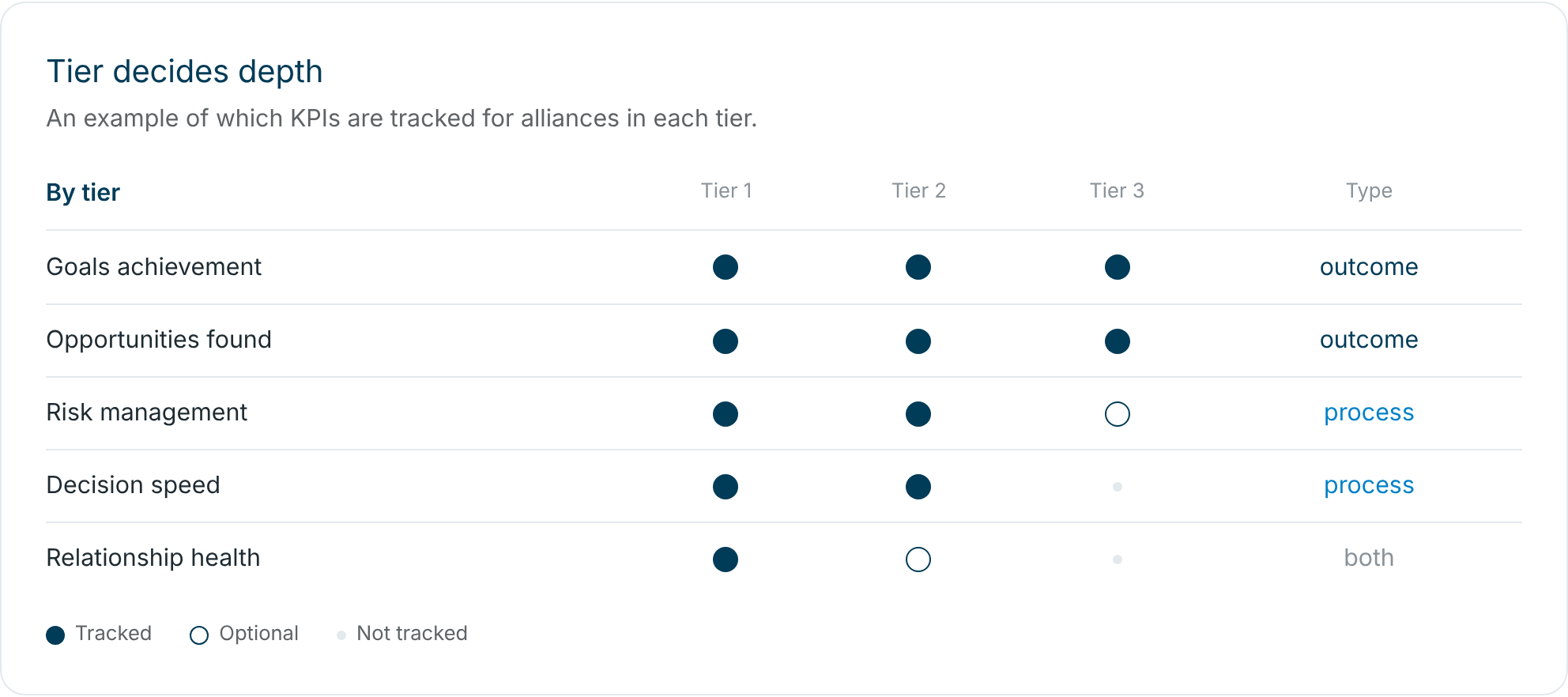
Here are five common KPIs in alliances across sectors. Some measure process effectiveness or efficiency, while others measure outcomes (and one measures both). For each, the table shows what type of measure it is. Process measures track day-to-day operations and ongoing relationship health to provide early feedback for real-time improvements, while outcome measures evaluate results against shared strategic goals to demonstrate the alliance’s ultimate value. The table also summarizes how each measure has traditionally been used, and how AI opens new ways to get prospective, proactive, and forecasting insights.

Goals achievement. With AI, it is now possible to go beyond the goal metric and its achievement status, and to gain insight into goals that may be at risk. For example, a slip in deliverables, a change in the partner’s portfolio priorities, or the departure of a key person on either side are early signals worth flagging.
Risk management. AI can assist with risk management by proactively going through every contract, amendment, plan, communication, slide deck, and set of minutes, looking for early warnings, recommending actions, and spotting patterns across the portfolio that can then be addressed more systematically, for example through process or contractual measures.
Decisions. AI can identify the patterns behind delays and typical decision-making times, and proactively flag the decisions that are needed.
Relationship health. AI can add a continuous signal between evaluations, for example by tracking the tone of meeting minutes and correspondence month to month. These signals give insights to alliance managers, who can then more proactively address issues before they become real problems and spot trends across alliances that can lead to more structural improvements in how organizations handle them.
Opportunities. AI can continuously search by connecting what is already in your records with external information and surface new ideas for consideration.
Which measures, where, and how
While it’s easy to produce KPIs with AI, not every alliance needs every KPI, and it is more important to focus on the right ones—the ones that will actually impact decisions and outcomes—than on volume.
One approach is to use tiers to decide which metrics are tracked and reported. A strategic, high-touch (Tier 1) alliance may justify all five. A lower-tier alliance may only need goals and opportunities. The nature and size of a partner portfolio, along with the needs of the stakeholders, should guide what is tracked and reported.
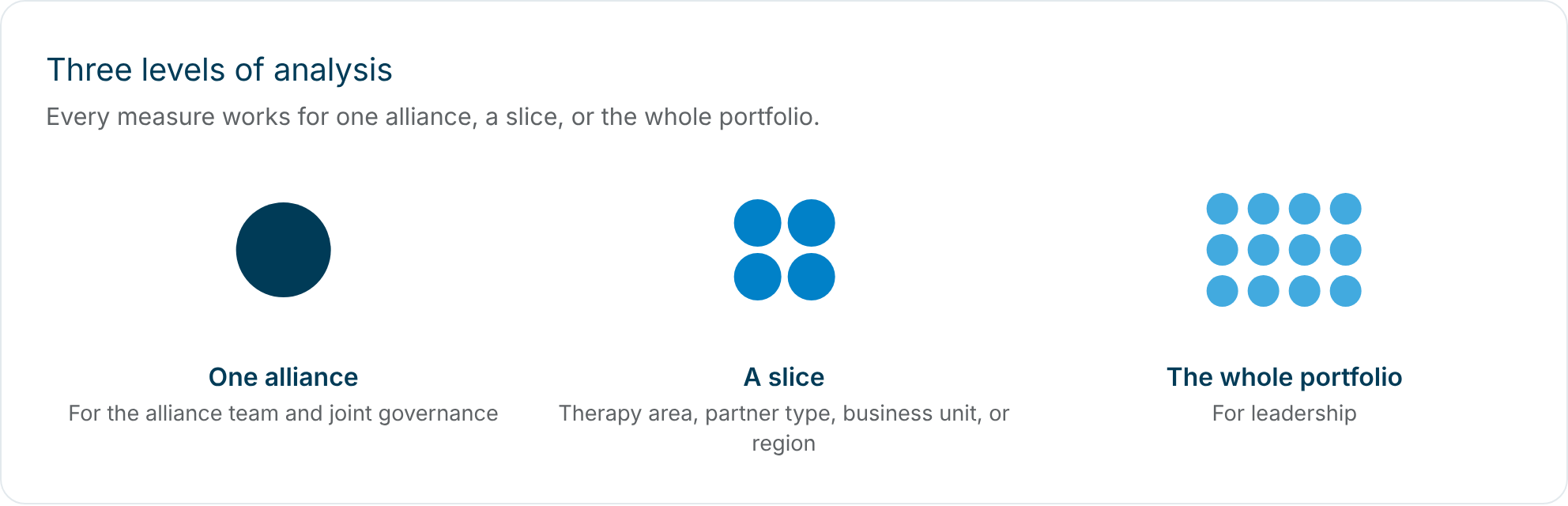
In a platform like allianceboard, with good-quality data on each alliance, every measure can be seen at three levels, and users can self-serve based on their needs at any moment:
- One alliance, for the alliance team and joint governance.
- A slice: a therapy area, partner type, business unit, or region.
- The whole portfolio, for leadership.
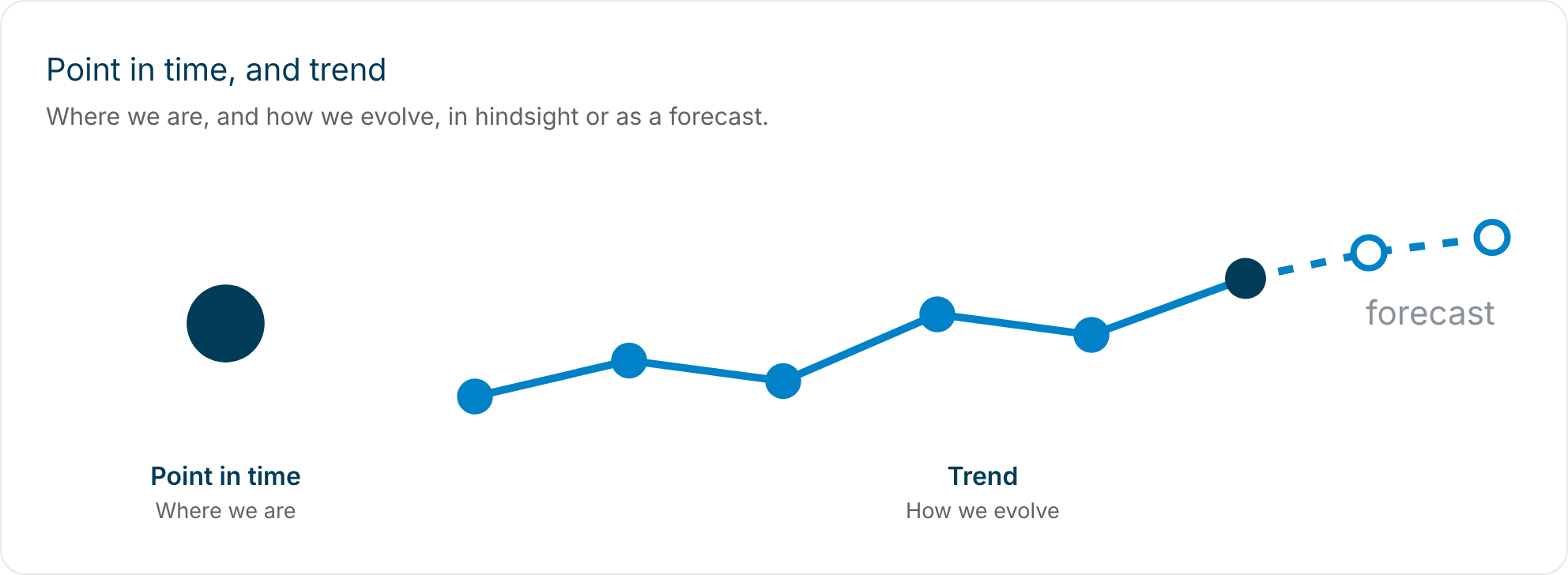
Each measure can also be explored in two time frames: a point in time, where we are now, and the trend, as the alliance evolves. Look at that trend in hindsight or project it forward as a forecast to build scenarios and plans.
Producing the metrics
As of late 2026, many alliance teams do not have a modern digital platform and still produce their metrics manually: gathering information from stakeholders in inconsistent formats, using predefined templates, or relying on IT to generate reports. By the time the numbers reach leadership, they are sadly out of date and not very useful.
Our 2026 State of AI in Strategic Partnering and Alliance Management survey shows evidence of the continuing prevalence of this pattern. Only 6% of respondents have built AI into their partnering processes and use it at a team, department, or corporate level. To date, it is still a case of individuals using AI the way they once used Excel, PowerPoint, and SharePoint: good tools, no doubt, yet still siloed and not adapted to alliance work.

The uses of AI that shape decisions are still rare: fewer than one in five respondents use AI to evaluate opportunities, forecast outcomes, or analyze alliance performance. With only 3% of respondents saying they are very confident in AI-generated intelligence for partnering decisions, and with accuracy and reliability as the top barrier—named by 56%—this is not surprising.
That is the gap worth closing. The time saved on drafting is real, but the bigger prize is better and faster decisions across the portfolio.
Degrees of automation in partnering and alliance management
To make the path forward concrete, consider five degrees of automation in partnering and alliance management. At each step, AI takes on more tasks, and the alliance manager’s role shifts from doing the work to directing it.

Most teams today sit at degree 1: AI drafts and summarizes, and people do the rest. The KPIs above really come into their own at degree 2, when the system tells you a decision is overdue or a deliverable is slipping before anyone needs to go looking (or gets blindsided). At degree 3, the system goes from flagging the slip to preparing the response: it drafts the re-baseline proposal and routes it for sign-off, and the alliance manager approves or edits it before anything moves. Degree 4 is still emerging, but joint governance is a natural place for it. Both partners already work from the same plan, so why maintain two versions of it?
The data comes first
As reported earlier, only 3% of our survey respondents are very confident in AI-generated intelligence, and that will not change until the data underneath it is reliable. Having a data strategy is therefore a prerequisite to moving up the automation ladder.
In practice, that means connecting the information partnering teams already produce. An alliance sits at the center of a web of records: the contract that governs it, the obligations it triggers, its goals and deliverables, its risks, the decisions its committees make, and the events it records. Upstream, it links back to the opportunity, the evaluation, the company, and the asset from search and evaluation and business development.
Once that data is connected, every measure discussed above is a question asked of your data:
- Decision speed: days between a decision being raised and being recorded.
- Risk coverage: share of high-priority risks with an owner and a plan.
- Goals achievement: deliverables met against their baseline dates.
The metric is no longer something you have to build every quarter. It is something you get on demand in modern digital platforms like allianceboard.
Integrating judgement in the right places
Even the most advanced technology requires a human-in-the-loop approach. Judgement must be integrated at two points in the workflow: data quality and decision-making.
- When data is confirmed. AI can find and extract information from pitch decks, contracts, minutes, presentations, and external sources such as clinical trial registries and news feeds. Someone who knows the alliance and understands the business context should review and approve the important items before they become part of the record.
- When consequential decisions are made. AI can flag the issue, gather the evidence, and draft the recommendation. Someone with the right level of understanding should then evaluate the information and decide. Particularly in the context of high-touch alliances with high-stakes decisions, this should be decision support, not decision automation.
Partnering and alliance teams must build these checkpoints into the workflow explicitly. Otherwise, reviews that depend on goodwill and spare time will not happen consistently, which leads to poor data and bad decisions.
The results speak for themselves
For teams that have made this shift, two things change.
First, the data entry barrier is significantly reduced. Working with AI to find and enrich data, alliance managers no longer chase updates and retype them into templates. They review and confirm what AI has found in the documents and sources they already use.
Second, every metric can now be served instantly. Reporting moves from fixed reports produced on a schedule to stakeholders asking their own questions, at the level and in the time frame they need. That frees alliance managers to spend their time where it counts: on the relationships, the alignment, and the decisions that make alliances succeed.
Looking ahead
Alliance metrics are shifting from describing the past to shaping what happens next. What separates the teams that benefit from those that don’t is trusted data, and judgement integrated in the right places. Both are within the alliance manager’s control, and with a purpose-built platform like allianceboard, they are easy to implement.
The conversation continues on October 27, 2026, in our free ASAP webinar, AI in partnering: what’s working today, what isn’t, what’s next, with Robert McBride (Exelixis), Louis Rinfret (allianceboard), Martin Svorc (Merck KGaA, Darmstadt, Germany), and Carlos Velez (Lacerta Bio).
See preliminary results from our 2026 State of AI in Strategic Partnering and Alliance Management survey, and complete it to receive the full 2026 report.
Book a demo of allianceboard, the AI-powered partnering and alliance management platform.